South Australia's First Nations Voice is a representative, legislatively created elected body for Aboriginal and Torres Strait Islander people.
Through the Voice, First Nations people can have their say at the highest levels of decision-making in South Australia on matters, policies and laws, and practices that affect them.
It provides an opportunity for Aboriginal and Torres Strait Islander people to raise community priorities in a public, transparent and accountable way.
First Nations Voice model
The First Nations Voice is an advisory body. It does not have veto powers or decision-making powers in South Australia's Parliament.
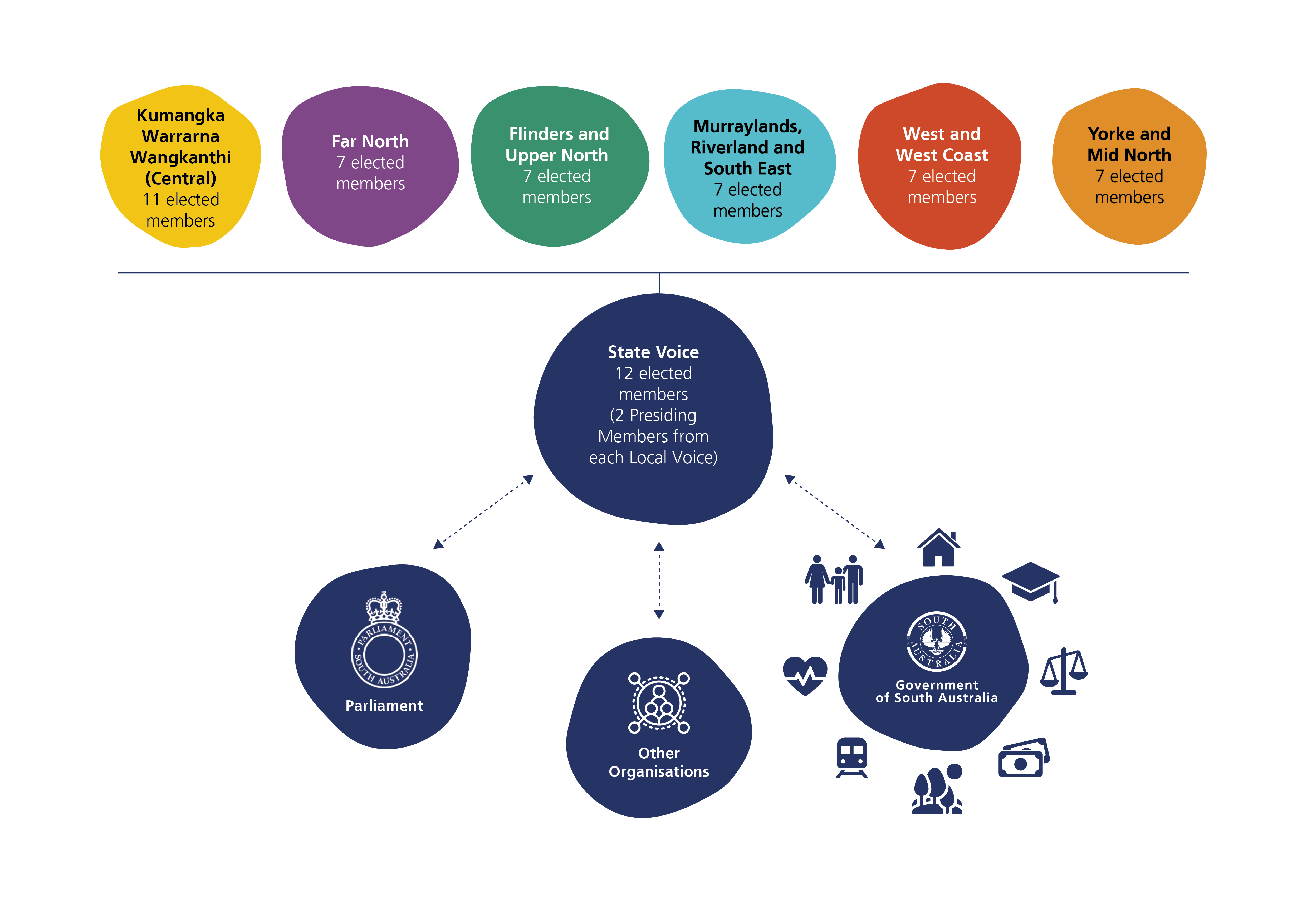
The Voice is made up of two levels - Local First Nations Voices (Local Voice) and a State First Nations Voice (State Voice), as represented in the infographic below. They work together but have different roles and responsibilities.
Local Voices
There are 6 Local Voice regions:
- Kumangka Warrarna Wangkanthi (Central) – 11 elected members
- Far North – 7 elected members
- Flinders and Upper North – 7 elected members
- Murraylands, Riverland and South East – 7 elected members
- West and West Coast – 7 elected members
- Yorke and Mid North – 7 elected members
State Voice
The State Voice has 12 members. Each Local Voice is represented by two Presiding Members from each Loval Voice. It functions as an advisory body to:
- speak with the South Australian Government, Cabinet and public sector chief executives
- make representations to the South Australian Parliament
- engage with other governments and organisations when appropriate.
It focuses on matters affecting Aboriginal and Torres Strait Islander people that can be addressed by the South Australian Government, including:
- employment
- education
- health
- child protection
- housing
- corrections and justice.
Local Voices may also engage with local government and other organisations. The State Voice may engage with the Australian Government and other states and territories.
This allows community stories, experiences and priorities raised with Voice members to be heard by the relevant government or organisation.